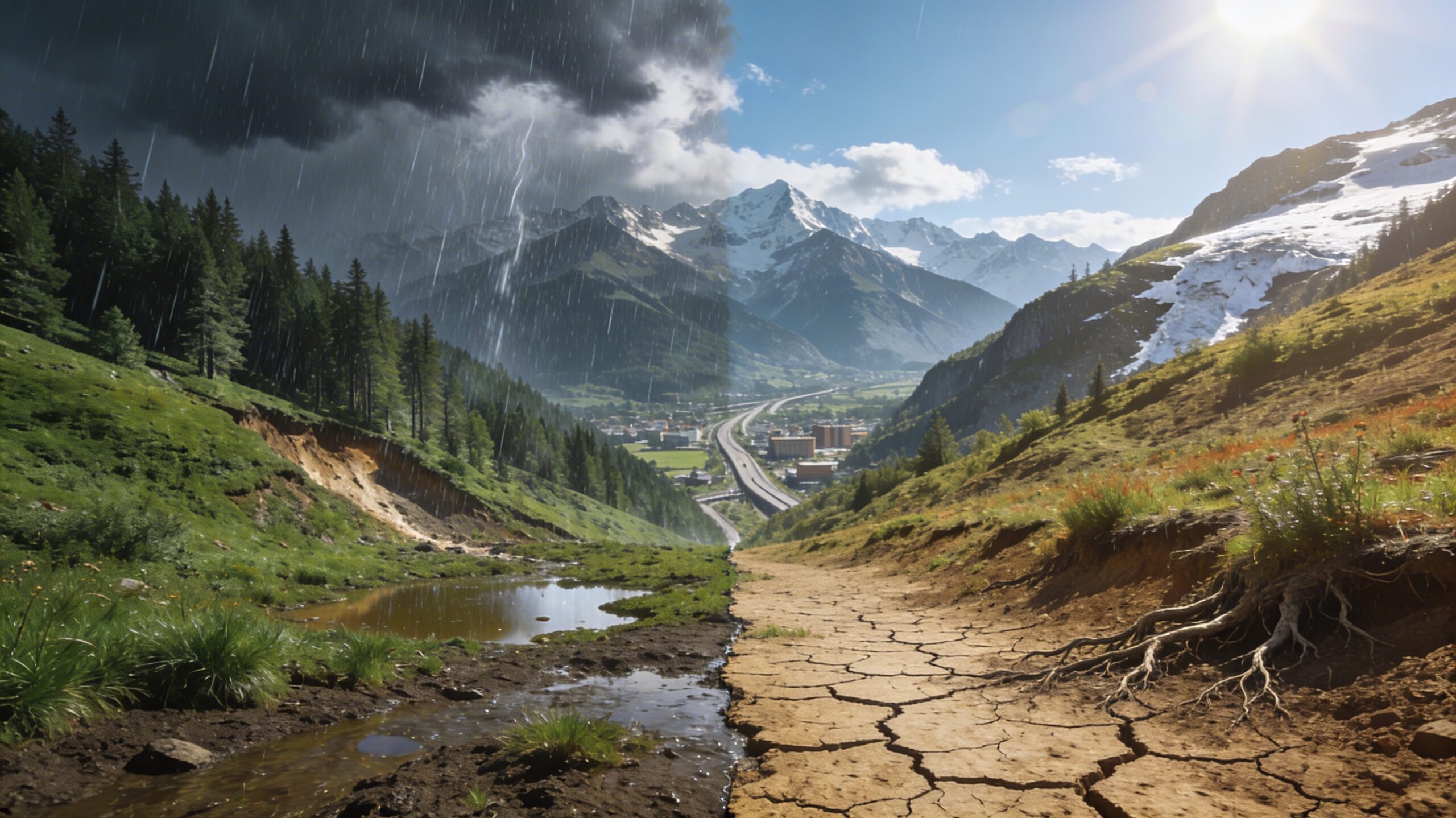
Climate change is influencing natural hazard patterns across Europe. One area of growing concern is the relationship between changing weather patterns and slope stability. Landslides are strongly connected to precipitation intensity, temperature variation, and environmental conditions.
Climate change does not directly create landslides. Instead, it modifies triggering factors and environmental processes that affect slope behaviour.
How climate change influences landslide risk
The relationship between climate change and landslides is complex. Several environmental processes contribute to changing hazard patterns.
Rainfall intensity and extreme precipitation
One of the most significant effects of climate change is the increase in short-duration high-intensity rainfall events in several European regions.
Heavy rainfall can increase groundwater pressure inside soil and rock formations. When pore pressure rises, effective mechanical strength decreases, making slope failure more likely.
Research indicates that intense precipitation events are becoming more frequent in parts of Southern and Central Europe, although regional variation is significant.
Seasonal hydrological changes
Long-term climate shifts influence seasonal water distribution.
- Changes in snow accumulation patterns
- Earlier snowmelt in alpine regions
- Variation in groundwater recharge cycles
Rapid snowmelt combined with rainfall can create short-term slope instability conditions.
Freeze–thaw cycle effects
Temperature fluctuations around the freezing point can weaken rock structures through repeated expansion and contraction.
This process is particularly relevant in mountainous regions and high-altitude infrastructure corridors.
Permafrost degradation in alpine regions
Permafrost refers to ground that remains frozen for long periods. In alpine and high-latitude European regions, warming temperatures are causing gradual permafrost reduction.
Permafrost contains ice that helps bind rock and soil particles. When ice melts, structural stability can decrease.
This effect is observed in parts of the Alps and other high mountain environments.
Vegetation changes and soil stability
Climate change may indirectly influence slope stability through ecosystem shifts.
- Vegetation roots help bind soil particles
- Deforestation or ecosystem stress can reduce slope reinforcement
- Wildfire activity can temporarily increase erosion risk
Vegetation effects vary significantly depending on local terrain and species composition.
Is climate change the main cause of landslides?
Geological and geomorphological conditions remain the primary determinants of landslide susceptibility.
Climate change acts mainly as a modifying factor that may increase trigger frequency or change seasonal risk distribution.
Many landslides still occur due to terrain characteristics, construction activity, or historical slope weakness rather than climate trends alone.
Observed trends in Europe
Long-term datasets show increased frequency of extreme rainfall events in several European regions. However, landslide occurrence trends are influenced by multiple variables, including land use and monitoring improvements.
It is difficult to attribute individual landslide events directly to climate change because slope failures are multi-factor processes.
Implications for infrastructure planning
Infrastructure resilience design must consider future environmental uncertainty.
Engineering practice in Europe increasingly integrates climate projection scenarios into long-term planning.
Examples of adaptation measures include:
- Improved drainage capacity in slope engineering
- Monitoring of high-risk transport corridors
- Reinforcement of existing retaining structures
- Risk zoning updates based on new data
Research and policy development in Europe
European research programmes have supported studies on climate-related geohazards. The work continues under collaborative research frameworks coordinated by the European scientific community and environmental agencies.
Policy discussions increasingly emphasise resilience rather than complete hazard elimination.
Uncertainty in climate-hazard modelling
Future landslide risk projections contain uncertainty because climate systems, geological processes, and human development interact in nonlinear ways.
Risk management strategies therefore focus on flexibility and adaptation rather than deterministic prediction.
Practical meaning for society
The main practical implication is that landslide risk management must consider long-term environmental change.
Authorities, engineers, and planners should treat climate trends as one component of risk evaluation rather than the sole driver of hazard.
Monitoring systems, updated hazard mapping, and maintenance of protective infrastructure remain essential.
Conclusion
Climate change is influencing landslide risk patterns in Europe by modifying precipitation, temperature cycles, and environmental conditions. While climate factors are important, geological structure, land use, and engineering design continue to play dominant roles in slope stability.
European Research Framework and Future Landslide Risk Studies
Research on climate-related landslide risk in Europe has been supported by collaborative scientific programmes coordinated by the European Commission and partner institutions.
Key organisations involved in geohazard research include the European scientific community, environmental monitoring agencies, and international research institutes working on hazard modelling and climate impact assessment.
Major European research initiatives relevant to this field include the Horizon Europe programme and Earth observation services provided through the Copernicus Programme.
The focus of modern research is shifting toward resilience-based risk management rather than attempting to eliminate natural hazard processes completely.
Key Research Themes
- Integration of climate projection scenarios into hazard assessment
- Improvement of monitoring networks in high-risk regions
- Adaptation of infrastructure design standards
- Multi-factor risk modelling under environmental uncertainty