European Research Framework on Landslide Triggering, Propagation and Risk Assessment
Work Package 1 (WP1) of the SafeLand FP7 project focused on understanding, modelling, and predicting landslide hazards across Europe.
The research integrates geomechanics, hydrology, seismic analysis, and runout modelling to support hazard zoning and Quantitative Risk Assessment (QRA).
Scientific Scope of WP1
WP1 addressed the full landslide hazard chain:
- Triggering mechanisms (rainfall, snowmelt, earthquakes)
- Slope deformation and progressive failure
- Hydromechanical numerical modelling
- Runout simulation and deposition processes
- Integration into risk assessment frameworks
The work combined regional-scale GIS susceptibility approaches with slope-scale finite element modelling and dynamic runout simulations.
WP1 Deliverables Overview
D1.2 – Climate-Driven Slope Deformation Mechanisms
Establishes the physical and constitutive framework linking rainfall and snowmelt to slope instability. Reviews European case studies, unsaturated soil mechanics, infiltration modelling, and progressive failure behaviour.
Focus areas:
- Static liquefaction in granular soils
- Progressive failure in overconsolidated clays
- Richards equation infiltration modelling
- Coupled hydromechanical slope simulations
D1.4 – Numerical Codes for Climate-Induced Landslides
Provides guidelines for selecting and applying finite element, finite difference, and GIS-based numerical tools for slope and regional modelling.
- Hydromechanical coupling procedures
- Shear Strength Reduction Method (SSRM)
- Preprocessing and validation workflows
- Early Warning System calibration
D1.7 – Landslide Runout Modelling
Reviews empirical, analytical, and numerical models for simulating rapid landslide propagation including rock avalanches and debris flows.
- Frictional and Voellmy rheologies
- SPH and depth-integrated models
- DEM sensitivity analysis
- Runout validation case studies
D1.8 – Model Selection for Quantitative Risk Assessment
Synthesizes WP1 research into practical guidelines for QRA applications across regional and site-specific scales.
- Rainfall-triggered instability modelling
- Seismic displacement estimation (Newmark method)
- Empirical and numerical runout integration
- Uncertainty and probabilistic considerations
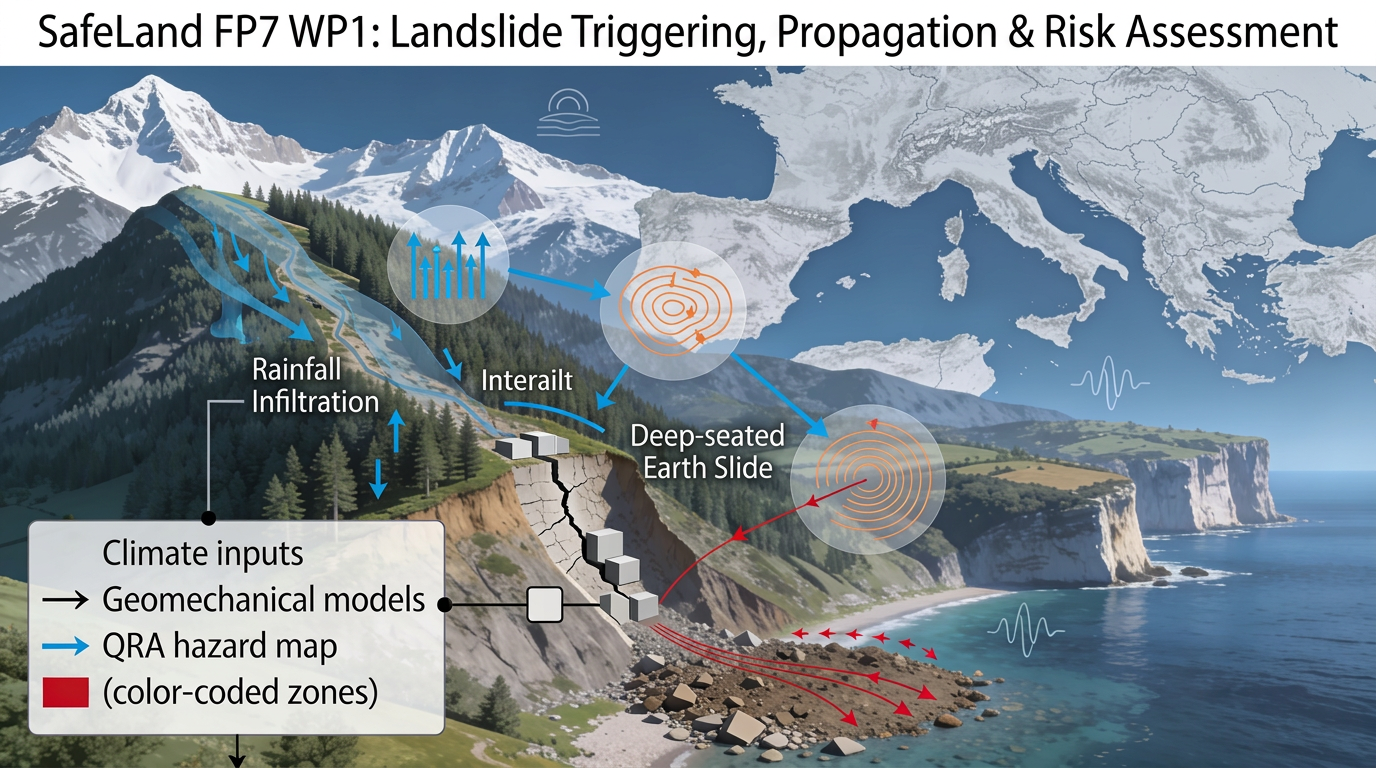
Integrated Hazard Modelling Framework
WP1 developed a structured modelling workflow:
- Environmental forcing (rainfall, snowmelt, seismic loading)
- Hydrological response (infiltration, pore pressure rise)
- Mechanical instability (factor of safety reduction, deformation)
- Runout propagation and deposition
- Risk quantification and vulnerability assessment
This integrated chain supports hazard zoning, early warning systems, and long-term climate scenario evaluation.
European Context
WP1 research was validated across diverse European environments:
- Alpine mountain slopes
- Italian pyroclastic terrains
- Glacial and moraine deposits
- Coastal and flysch formations
The framework supports harmonised landslide risk assessment across EU member states.
Relevance for Hazard and Risk Management
- Improved susceptibility mapping
- Early warning threshold development
- Scenario-based climate adaptation planning
- Evidence-based land-use planning support
WP1 established a scientific bridge between slope mechanics research and operational risk assessment tools.
About the SafeLand FP7 Project
SafeLand (Living with landslide risk in Europe) was a collaborative European research initiative under the Seventh Framework Programme (FP7), aimed at advancing landslide hazard and risk management methodologies.
Work Package 1 forms the scientific core of the hazard modelling component of the project.