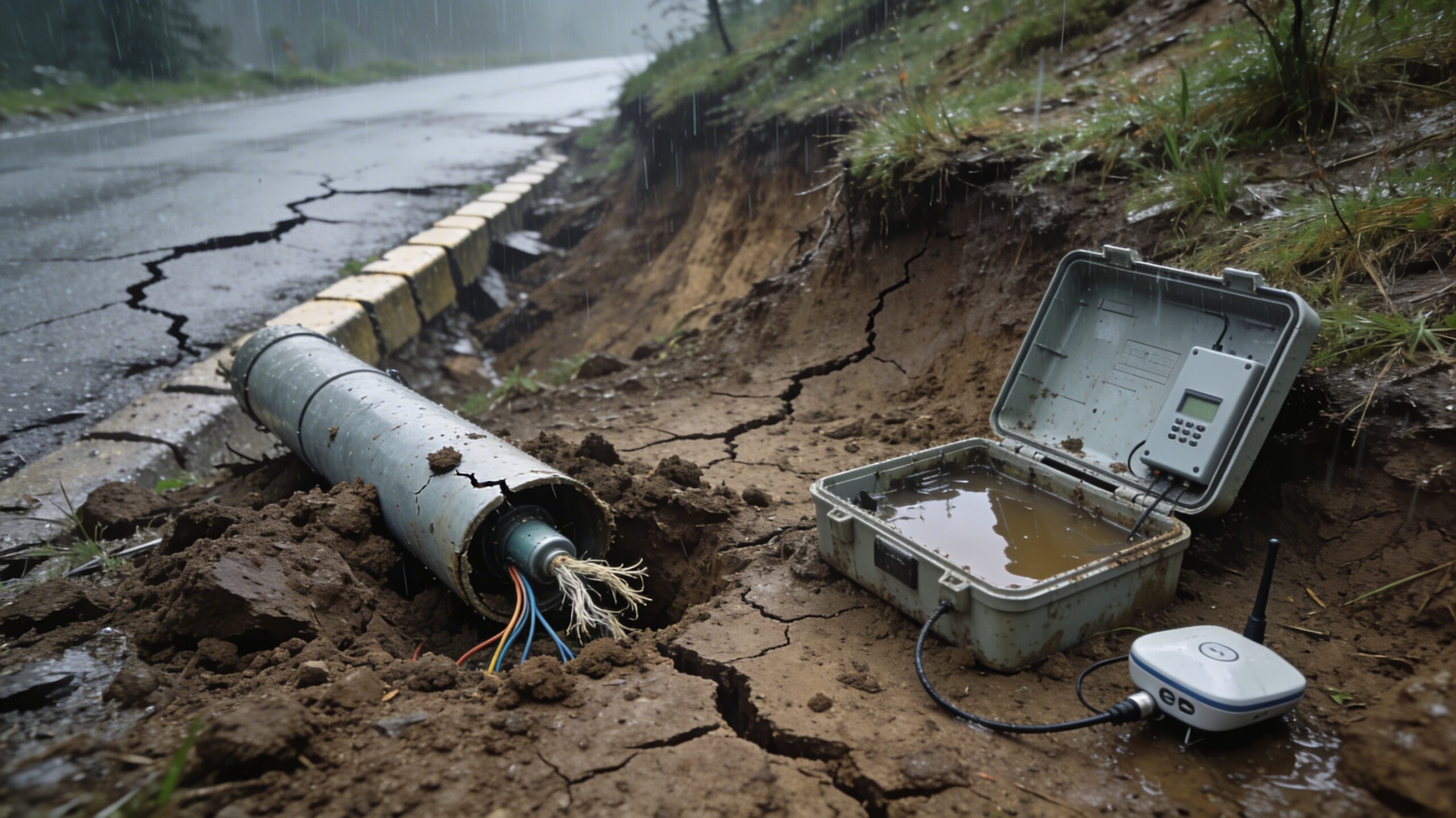

Landslide early warning systems are an important component of modern natural hazard management. These systems are designed to detect environmental or ground movement signals that indicate increased slope failure risk.
Despite technological progress, early warning systems do not guarantee protection against landslides. In practice, several technical, environmental, and organisational factors can reduce system effectiveness.
This article explains why early warning systems sometimes fail and what limitations exist in operational deployment.
Why early warning systems are not prediction machines
Many people assume early warning systems can predict landslide events. This is a misunderstanding.
Current technology focuses on risk signalling rather than precise prediction of failure timing.
Most operational systems are based on threshold monitoring. When measured variables exceed predefined safety levels, alerts are generated.
Research and operational experience coordinated by organisations such as the :contentReference[oaicite:0]{index=0} indicate that uncertainty remains an inherent characteristic of landslide hazard management.
False alarms: The most common operational challenge
False alarms occur when warning systems trigger alerts but no landslide event follows.
False positives are common in conservative safety designs. Authorities sometimes prefer higher false alarm rates because missing a real landslide event can have catastrophic consequences.
However, frequent false alarms can reduce public trust. If communities experience repeated warnings without visible consequences, compliance with evacuation instructions may decline over time.
Balancing safety sensitivity and social reliability is a major design challenge.
Missed detections and silent failures
The opposite problem is missed detection, where a landslide occurs without warning.
Several factors can cause missed events:
- Low sensor density in large terrain areas
- Rapidly developing slope failures
- Instrumentation malfunction
- Unmodelled geological conditions
- Communication network disruption
Some landslides develop within minutes or hours, leaving limited time for detection even with modern monitoring systems.
Sensor infrastructure limitations
Early warning systems depend on physical hardware installed in terrain environments.
Power supply reliability
Remote monitoring stations often rely on batteries, solar panels, or local grid connections.
Extreme weather conditions can disrupt power stability.
Communication network vulnerability
Telemetry systems transmit data to control centres.
Mountainous terrain can interfere with signal transmission.
During storms, communication infrastructure may be damaged or overloaded.
Maintenance requirements
Long-term monitoring programs require regular field inspection.
Sensor drift, corrosion, mechanical wear, and calibration errors can reduce measurement accuracy over time.
Maintenance is often the most underestimated cost component of monitoring programs.
Rainfall threshold model uncertainty
Many European early warning systems rely on rainfall threshold modelling.
These models estimate landslide probability when cumulative precipitation exceeds predefined limits.
Thresholds are usually calibrated using historical landslide inventories.
However, rainfall thresholds are not universal. They vary by:
- Geology
- Soil structure
- Vegetation cover
- Terrain slope angle
- Regional climate patterns
Improper calibration can lead to either excessive alarms or undetected hazards.
Human factors in warning system failure
Technology alone does not guarantee effective hazard management.
Organisational and behavioural factors play a significant role.
Communication breakdown
Warning messages must be clear and actionable.
Ambiguous communication can create confusion during emergency situations.
Decision-making delays
Authorities may hesitate to issue evacuation orders due to economic or social concerns.
Delayed response can increase exposure risk.
Public compliance challenges
If communities do not trust warning systems, evacuation instructions may not be followed.
Building public awareness is therefore part of technical risk management.
Infrastructure context matters
Early warning systems are most effective when integrated into broader risk management frameworks.
These frameworks typically include:
- Hazard mapping
- Engineering mitigation structures
- Regular terrain inspection
- Emergency response planning
Monitoring without response planning provides limited protection.
Operational responsibility in Europe
In Europe, natural hazard management is usually handled at national or regional level.
Research guidance and methodological development are supported by European scientific collaboration, but implementation is decentralised.
This means system quality can vary between regions.
Future research directions
Current research explores the integration of artificial intelligence, multi-sensor fusion, and automated decision support systems.
Machine learning models are being tested to identify deformation patterns preceding slope failure.
However, these technologies are still under evaluation for operational reliability.
Practical meaning for society
Early warning systems reduce landslide casualties when properly implemented, maintained, and supported by public communication strategies.
They are risk reduction tools rather than absolute safety guarantees.
Real-world effectiveness depends on engineering quality, institutional coordination, and community participation.
Landslide early warning systems improve hazard management but have operational limitations. False alarms, missed detections, infrastructure maintenance, and human communication factors all influence performance. Future improvements will likely come from better data integration rather than from prediction certainty.