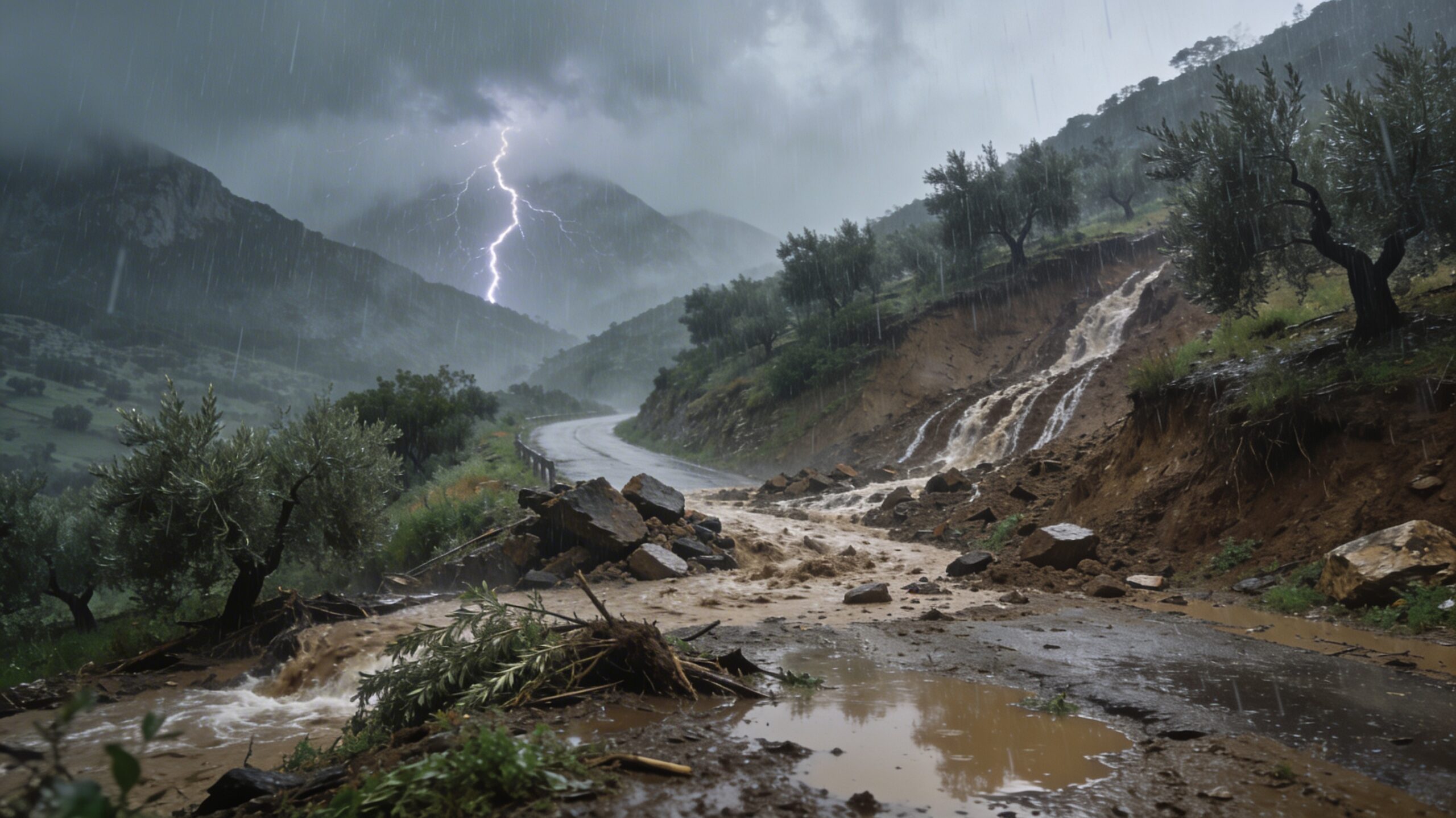

Several European regions have experienced intense rainfall events in recent years, raising concerns about landslide activity. Extreme precipitation is one of the primary environmental triggers of slope failure.
In 2026, public discussion of natural hazards has increased following several damaging events, including the landslide incident reported in parts of Southern Europe associated with heavy rainfall conditions.
This article examines why rainfall intensity is becoming a more important factor in landslide risk and what this means for hazard management.
Heavy rainfall and slope failure mechanisms
Rainfall influences landslide risk primarily by changing groundwater pressure inside soil and rock structures.
When rainwater infiltrates ground layers, pore water pressure increases. Higher pore pressure reduces effective stress, which decreases frictional resistance along potential failure surfaces.
If rainfall continues for long enough, slopes that were previously stable can transition into unstable conditions.
This process is especially relevant in areas with clay-rich soil formations or fractured rock structures.
Why rainfall intensity matters more than total rainfall
Research observations suggest that rainfall intensity often plays a larger role than total precipitation volume.
Short-duration extreme rainfall can overwhelm surface drainage capacity and rapidly increase infiltration rates.
European climate monitoring data has shown an increase in high-intensity precipitation episodes in some regions.
However, regional variation is significant, and trends are not uniform across the continent.
Urban expansion and exposure increase
Landslide risk is not determined by hazard probability alone.
Risk also depends on exposure. When development expands into hilly terrain, the number of people and assets located in potential failure zones increases.
In many European regions, infrastructure built decades ago may now be located in areas where hazard knowledge has improved but physical relocation is not practical.
Risk management therefore focuses on mitigation and monitoring rather than large-scale relocation.
Role of vegetation and land use changes
Vegetation contributes to slope stability through root reinforcement and surface erosion control.
Changes such as:
- Deforestation
- Wildfire damage
- Urban surface sealing
- Agricultural modification
can modify slope hydrology and mechanical stability.
Early warning systems and rainfall thresholds
Many European regions operate rainfall threshold warning models.
These systems are designed to issue alerts when cumulative precipitation exceeds locally calibrated values.
Operational monitoring networks are often managed by national geological or civil protection authorities such as the :contentReference[oaicite:0]{index=0}.
However, threshold models have limitations. False alarms may occur, and not all landslides are preceded by measurable signals.
Climate change and rainfall pattern uncertainty
Climate research suggests that warmer atmospheric conditions can increase moisture capacity, which may contribute to more intense precipitation events.
It is important to avoid simplifying this relationship.
Climate change does not directly cause landslides. Instead, it modifies environmental conditions that influence triggering probability.
What this means for European infrastructure
Transport corridors, mountain settlements, and utility networks are particularly sensitive to slope instability.
Engineering practice increasingly incorporates probabilistic safety design rather than relying solely on historical stability assumptions.
Maintenance of drainage systems is becoming more important as precipitation extremes increase.
Limitations of current prediction capability
Despite advances in satellite monitoring and machine learning research, precise prediction of individual landslide timing remains difficult.
Current technology is more effective at identifying risk zones and deformation trends than predicting exact failure moments.
Practical risk reduction strategies
Effective landslide risk management combines multiple approaches:
- Hazard mapping and zoning
- Ground and satellite monitoring
- Engineering reinforcement
- Public warning communication
- Regular infrastructure inspection
No single method provides complete protection against slope failure.
Future outlook
European research communities continue improving multi-source data integration for hazard assessment.
Development is focused on combining ground sensors, remote sensing, and environmental modelling.
Operational deployment of advanced AI-based prediction systems is still limited and under evaluation.
Related knowledge areas:
– Landslide Risk in Europe
– Monitoring and Early Warning Systems
– Climate and Slope Stability
Summary
Heavy rainfall is becoming an increasingly important factor in European landslide risk discussions. Rising precipitation intensity, land-use pressure, and climate variability contribute to changing hazard patterns. However, geological structure and human exposure remain fundamental determinants of overall risk.